
Reviewed · PRAGUE COMMUNISM TOURS
20th Century Prague: WW2 and Communism
Prague leaves clues in plain sight. This 3-hour walk strings together major 20th-century turning points across central Prague, so you see how independence, occupation, and resistance shaped everyday places. I love the way the route keeps you moving with clear stops instead of long museum detours.
What I like most is the small group size, capped at 10 people. It feels easier to ask questions and follow the story as you go, and the guide can pace the talk for an English-speaking group. The other win is that the listed stops are admission free, so you are not paying extra just to step onto the right streets.
One drawback to consider: it is a lot of thinking in a short time. Each stop is brief, about 10 to 40 minutes, so if you prefer deep museum time, you may want to add a longer visit on your own after.
In This Review
- Quick hits to expect
- A 3-hour Prague walk through WW2 and Communism
- Price and value: about $107 for a story you can walk through
- Start at the Powder Tower, then the Municipal House independence moment
- Vaclavské náměstí: the public square where politics plays out
- Lucerna Arcade and the Havel family link
- Pasáž Svatého šozo r and the idea of a time capsule
- The Franz Kafka spinning head: history as culture and symbol
- National Theater and Vaclav Havel, from dissident to president
- Narodní třída and the hands reaching out of the wall
- The Heydrich terror memorial crypt: ending with resistance at the final stand
- Walking pace, group size, and who this fits best
- The guide factor: what a name like Klára signals
- Practical details that help your day go smoothly
- Should you book 20th Century Prague: WW2 and Communism?
- FAQ
- How long is the 20th Century Prague: WW2 and Communism tour?
- What is the tour language?
- How many people are in the group?
- Where does the tour start and end?
- Are there admission tickets for the stops?
- What time does the tour start?
- Is free cancellation available?
Quick hits to expect
- Start at the Powder Tower and end by the Heydrich terror memorial crypt, so the story has a clear arc.
- Eight stop points built around real sites tied to independence, occupation, dissent, and revolution.
- Mostly outside, lots of walking, with short time windows at each location to keep the energy up.
- English guide with a mobile ticket, and a group size of up to 10 people.
- Free entry at the listed stops, which helps you control your total trip cost.
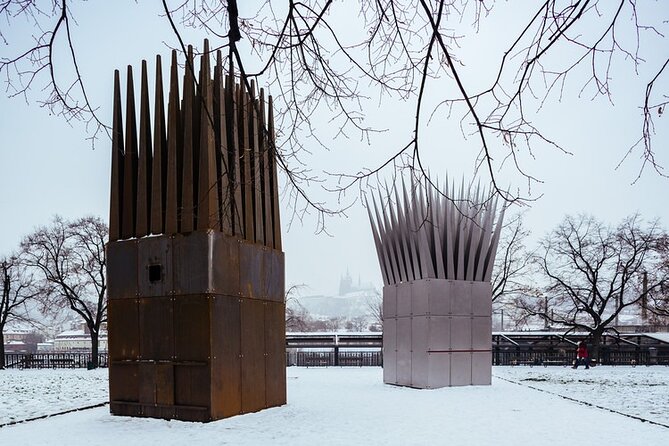
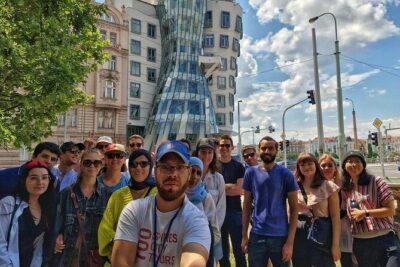
- Frank Gehry sighting en route, a modern contrast to the 20th-century themes.
A 3-hour Prague walk through WW2 and Communism
If you want the 20th century in Prague to make sense fast, this kind of focused walking tour is a smart move. The duration is about 3 hours, and the schedule is built around short, high-impact stops. That means you get the big ideas without getting bogged down in ticket lines or spending half a day inside one building.
You’ll spend most of your time outdoors or in quick-inspection moments close to the street, with additional time kept for walking and for taking a breather if you need it. The pacing is designed for an English group, and the tour runs as a small group, maximum 10 people. That small size matters, because the story is not just names on plaques. It is tied to where you stand, and that works better when the group is not too large.
More of the years behind the Iron Curtain:
- Prague: Communism History and Nuclear Bunker Guided Tour
★ 4.7 · 2,417 reviews - Prague Communism History and Nuclear Bunker Tour
★ 5.0 · 1,742 reviews - Communism & Nuclear Bunker Tour + 70s Canteen Lunch (own expense)
★ 5.0 · 1,036 reviews
Price and value: about $107 for a story you can walk through
At $107.63 per person for an approximately 3-hour guided experience, the value comes down to one key question: do you want someone to connect the dots for you?
In this case, the answer looks promising. The itinerary includes major sites and monuments tied to independence, political power, dissent, and resistance. The time cost is reasonable, and you avoid surprise add-on fees at the stops because the listed admission tickets are free. So most of what you pay for is the guide’s explanation and the convenience of having the route mapped.
Also, the tour uses a mobile ticket, which usually means less hassle on the day. There are group discounts too, which can make it even more cost-effective if you are traveling with friends or family who can join you.
Still, set expectations: this is not a full-day deep dive into one museum. It is a targeted route. If you love reading on your own or you already know Prague’s timeline well, you might find that a self-guided walk plus a book could do the job. But if you want clarity and context quickly, this format helps a lot.
Start at the Powder Tower, then the Municipal House independence moment
The tour begins at the Powder Tower on Náměstí Republiky, a solid launch point for getting oriented in Prague’s Old Town area. Starting here is practical. You are already in a part of the city that feels central to how Prague grew and how power became visible in public spaces.
From the start, you head to Obecní dům (Municipal House). This is the kind of building where history hits you in the face, because the setting is so grand. It is also the site tied to a key milestone: in 1918, the declaration of independence of Czechoslovakia was signed here.
That detail matters. It turns the Municipal House from a pretty stop into a political one. When you see ornate architecture next to a document-signing moment, you get a better sense of how early 20th-century leaders wanted legitimacy to look official and lasting. You are standing in a place where the new state tried to present itself as real, not temporary.
There’s also a practical upside: the stop is short, around 10 minutes. You get the main point, and then you move on while the story is still fresh.
Vaclavské náměstí: the public square where politics plays out
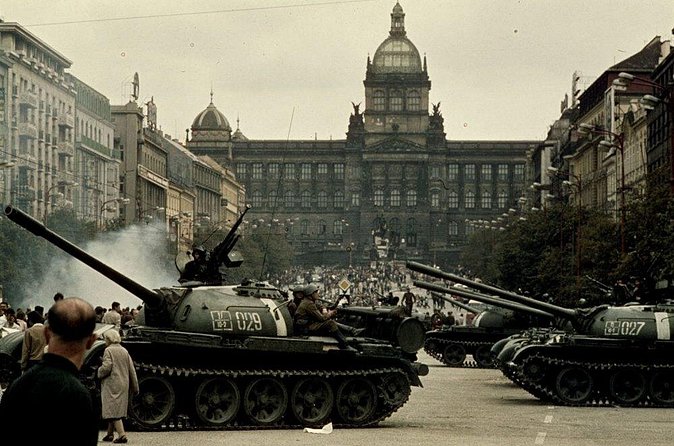
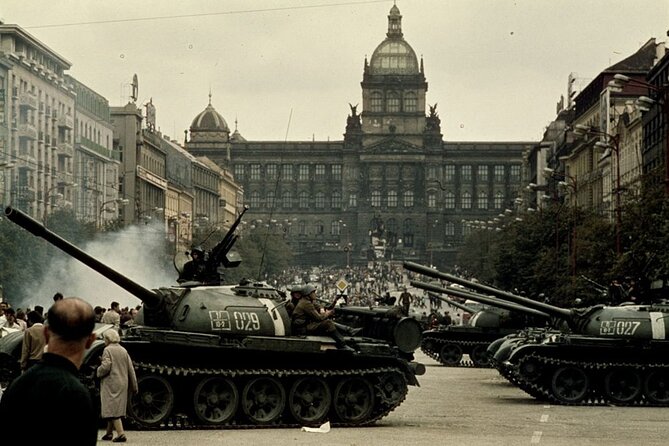
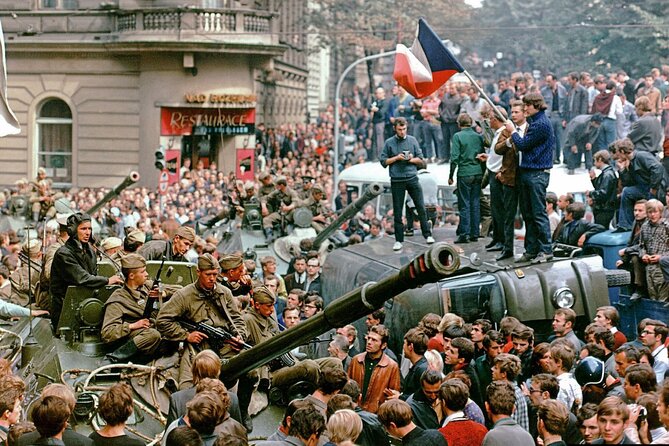
Next comes Václavské náměstí, one of Prague’s main squares. This stop is about 40 minutes, which tells you the tour expects you to linger a bit. A square like this is not just scenery, it is the stage where big events become visible to the public.
In the tour framing, this is where some of the turning points of the 20th century took place. Even if you have only partial background, the square helps you understand why public space became a megaphone. When regimes shift, people need places where the message can be shared, argued, protested, or celebrated.
Spend your time here with a simple approach: look at the scale, then think about who could gather, who could watch from surrounding streets, and how a crowd becomes part of the political story. That mental picture helps the next parts of the tour land better.
The practical reminder: because this is a large open area, it can feel longer than 40 minutes on a busy day. Wear comfortable shoes and plan to stay present rather than trying to squeeze in photos every few seconds.
Lucerna Arcade and the Havel family link
After the big public square, the tour shifts to the more intimate rhythm of the city center through Lucerna Arcade. You walk through the famous Lucerna Palace area, built by the Havel family in the early 20th century.
This is a clever contrast. Big squares show public power. These indoor, elegant corridors show how influence and resources shaped the city’s culture. The Havel family connection also threads forward in the tour, because the name Vaclav Havel shows up later.
If you like history that follows people across multiple decades, this is where you start seeing how a family name ties architecture to political life. You might not connect it instantly on your first glance. That is normal. The guide’s job here is to connect the dots while you are still in the right place to understand them.
The walk-through time is about 10 minutes, so treat it as a quick orientation stop. Look up. Notice how a commercial, cultural space can hold symbolic meaning when political life changes.
Another way the same evening in Prague could go:
Pasáž Svatého šozo r and the idea of a time capsule
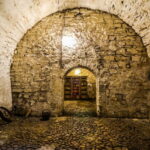
Next is Pasáž Světozor, described as a time capsule in the heart of Prague. This stop is short, about 10 minutes, but it is designed to make you think.
What makes a place feel like a time capsule is not a single object. It is the feeling that the space carries old patterns, old craftsmanship, and old everyday behavior. In a tour focused on WW2 and Communism, that matters because these eras did not just change governments. They changed how people lived, shopped, gathered, and moved through the city.
Even if you do not have specific details about the passage’s background, you can use the stop as a mental reset. Ask yourself: what parts of the city stayed recognizable, and what parts changed so dramatically that people felt the difference right away?
Short stops like this work best when you slow down for a minute and just look around.
The Franz Kafka spinning head: history as culture and symbol
Then you reach the Franz Kafka statue, the famous spinning head. It is another quick stop, about 10 minutes, but it adds a needed ingredient to a tour otherwise heavy with politics.
Kafka is not just a tourist name. He is part of Czech cultural identity, and his presence in this route signals something important: life under shifting regimes is not only about laws and violence. It is also about ideas, writing, and the way people process fear and control.
Even if you are not a Kafka superfan, you can treat the spinning head as a visual cue. It is small, playful, and easy to miss, which is exactly why it works here. It reminds you that the city’s 20th century story is not all grim. Culture persists, adapts, and sometimes cracks through in unexpected ways.
National Theater and Vaclav Havel, from dissident to president
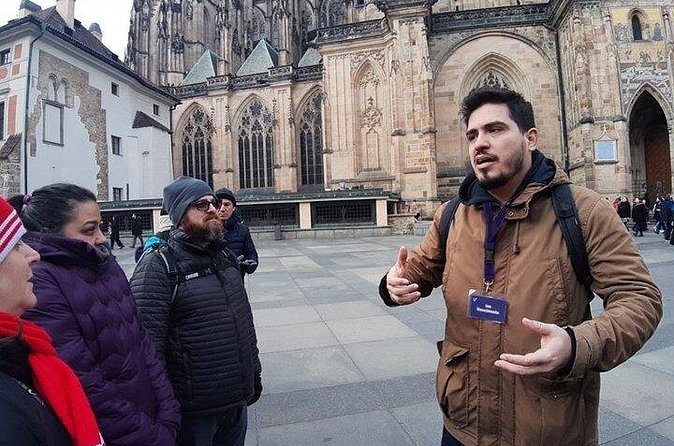
The tour continues to the National Theater, where you visit the monument to dissident turned president Vaclav Havel. This is another major emotional hinge in the itinerary.
Havel’s arc, from dissident to president, is the kind of story you cannot fully understand from a single plaque. You need to feel the shift from someone punished or sidelined to someone recognized by the state. That monument, placed at a landmark like the National Theater, ties politics to national identity.
This is also where the earlier Havel family detail from Lucerna Arcade starts to feel more meaningful. You are not just learning names. You are watching how the tour connects family, culture, resistance, and leadership across time.
The stop is about 10 minutes, so give yourself permission not to absorb everything in one glance. Instead, focus on the direction of the story: resistance led to change, and change led to new leadership.
Narodní třída and the hands reaching out of the wall
Next comes one of the most striking stops on the route: the Hands reaching out of the wall on Narodní třída, described as the place where the Velvet Revolution began. This is about 10 minutes, but the impact can feel bigger because the site is so visual.
If you have only heard the phrase Velvet Revolution, this is where your understanding gets physical. The hands motif is not subtle. It is a symbol of people reaching out for a different future and pushing back against control.
The practical lesson here is simple: political change often starts as emotion before it becomes policy. A site like Narodní třída helps you remember that revolutions are made of bodies in streets, not just decisions in offices.
Because the stop is short, focus on posture. Stand where you can see the hands clearly, and take a moment to notice the surrounding street context. That helps you picture the moment in motion.
The Heydrich terror memorial crypt: ending with resistance at the final stand
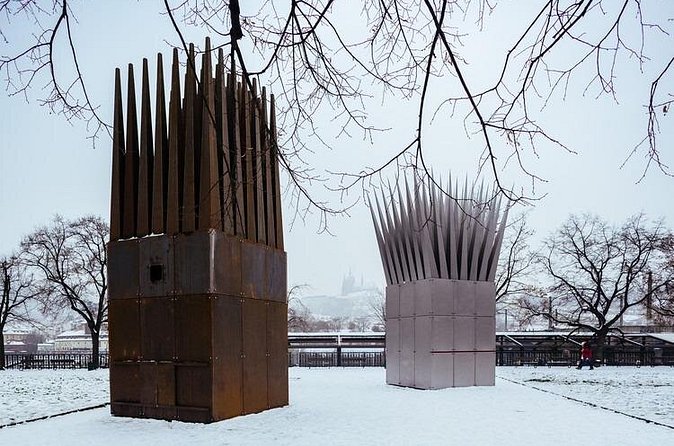
The tour finishes at the National Memorial to the Heroes of the Heydrich Terror, specifically at the crypt where the assassins of Heydrich made their final stand. This is the darkest endpoint on the route, and it closes the loop from WW2 era events to post-war memory.
Finishing in a crypt changes your emotional tempo. Earlier stops have open space, street life, and public squares. Here, the idea of a final stand is literal and solemn. Even if you do not know the full historical background, the framing is clear: this place is dedicated to people whose actions were meant to stop or disrupt terror and occupation.
It also makes the tour’s overall structure feel intentional. You start with independence and national self-definition. Then you move through public power, cultural persistence, dissidence, and revolution. Ending at this memorial gives the story a hard edge, a reminder that the 20th century in Prague was not abstract.
After the tour ends, you are already at a location that is set up for continued exploration. You will be near the ending point on Dittrichova in the Nové Město area.
Walking pace, group size, and who this fits best
This tour works best if you like a clear timeline and short stops that keep you moving. Each stop is listed as relatively brief, so you will not feel stuck in one place. At the same time, you will not get lost in information overload.
The maximum group size of 10 people is also a big deal for comfort. You are close enough to hear the guide without fighting through crowds, especially at smaller sites like statues and passages.
Also, it is offered in English. If you do not speak Czech, that is essential. Language matters most in history tours because it is not just facts. It is the tone, the connections, the reasons behind events.
As for who should do it: it is ideal for first-timers who want a guided framework for Prague’s WW2 and Communism era. It is also a good fit for people who want a meaningful history walk without committing to a full museum day.
If your priority is deep museum time, long indoor interpretation, or you want a slower pace with more sitting, you might prefer a different style of tour. The route here is designed for movement and quick clarity.
The guide factor: what a name like Klára signals
One detail that stands out from high praise is the guide. In feedback about the experience, Klara is highlighted as friendly, pleasant, and able to explain Prague and Czech culture in ways that feel new. That lines up with why this tour works at all.
When a guide can make the city’s symbols and slogans feel connected to real life, you come away with more than dates. You come away with a sense of what people valued, what they feared, and how culture and politics kept rubbing together.
So if you see Klára as your guide, that is a strong sign. Even without that detail, look for a tour that emphasizes story connections, not just where things happened.
Practical details that help your day go smoothly
- Start time is 11:00 am, so plan your morning accordingly.
- The meeting point is Powder Tower, Nám. Republiky 5, and you finish at Dittrichova 1940/16 near the crypt.
- It is English and uses a mobile ticket.
- It is near public transportation, which makes it easier to pair with other plans before or after.
- Service animals are allowed.
- Most travelers can participate, and the rest of the time is for walking and consideration.
One small strategy: keep your notes simple. Instead of trying to write everything, jot down three names or themes that link your day, like independence in 1918, Vaclav Havel, and the Velvet Revolution. When you do that, the tour stops feeling like a sequence of random landmarks and starts feeling like a story.
Should you book 20th Century Prague: WW2 and Communism?
Book it if you want a structured way to understand Prague’s political shifts without spending a full day in one place. The route hits the key anchors, the stops are admission free, and the small group format makes it easier to follow the explanation. At about $107.63 for roughly 3 hours, it is a fair price when you value guidance and context over self-navigation.
Skip it or pair it with other activities if you need long indoor time, or if you are the type who wants to read every plaque without time pressure. This is a brisk, focused walking experience, not a marathon museum session.
If your goal is to leave Prague feeling oriented, with a clearer link between WW2, Communism, dissidence, and revolution, this tour is a practical choice. It is built for people who like their history tied to the street.
FAQ
How long is the 20th Century Prague: WW2 and Communism tour?
It is approximately 3 hours.
What is the tour language?
The tour is offered in English.
How many people are in the group?
The tour has a maximum of 10 travelers.
Where does the tour start and end?
It starts at the Powder Tower, Nám. Republiky 5, Staré Město, and ends at Dittrichova 1940/16, Nové Město, at the crypt.
Are there admission tickets for the stops?
The listed stops show admission ticket free.
What time does the tour start?
The start time is 11:00 am.
Is free cancellation available?
Yes. You can cancel up to 24 hours in advance for a full refund. If you cancel less than 24 hours before the start time, the amount paid is not refunded.
Just written up in Prague
- Private Transfer from Prague to Regensburg★ 5.0 · 1 review
- Prague: TV Tower Ticket & Novi Grad Digital Tour★ 5.0 · 1 review
- Prague to Dresden’s Old Town, Zwinger & Frauenkirche by Car★ 3.0 · 1 review
- Prague to Český Krumlov Private Guided Tour – With Mike★ 5.0 · 1 review
- Prague to Munich Private Transfer with 2 hours sightseeing★ 5.0 · 1 review
- Prague: 3-Hours Wars & Totality Guided Walking Tour★ 5.0 · 1 review
- Prague to Berlin Private Transfer with Optional Sightseeing★ 5.0 · 1 review
- The Plague Doctor of Prague: Self-Guided Mystery Puzzle Walk★ 3.0 · 1 review
Prague Communism Tours, compared.
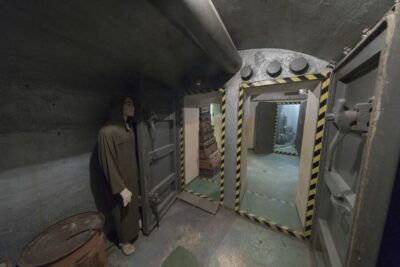
Communism History and Nuclear Bunker Guided Tour
Read our review →
Prague Communism History and Nuclear Bunker Tour
Read our review →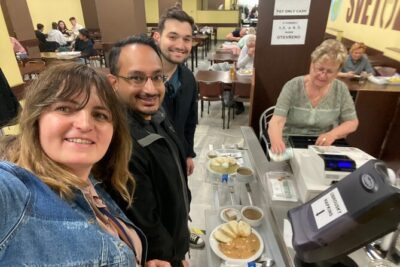
Communism & Nuclear Bunker Tour + 70s Canteen Lunch (own expense)
Read our review →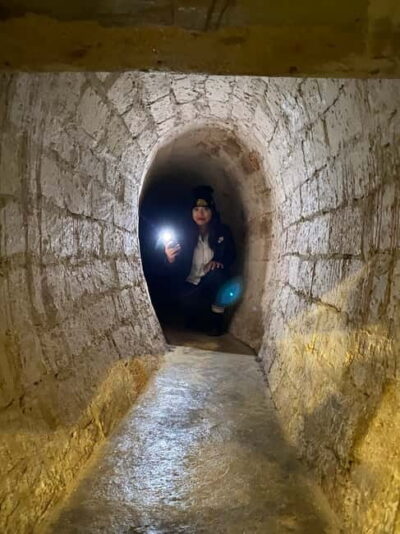
Communism and Bunker Tour with 70s Canteen Lunch
Read our review →
Second World War & Communism (Tip-based 3 hour tour)
Read our review →
Browse the lists this tour appears in