
Reviewed · PRAGUE GUIDED WALKING TOURS
Private Prague Cold War Walking Tour
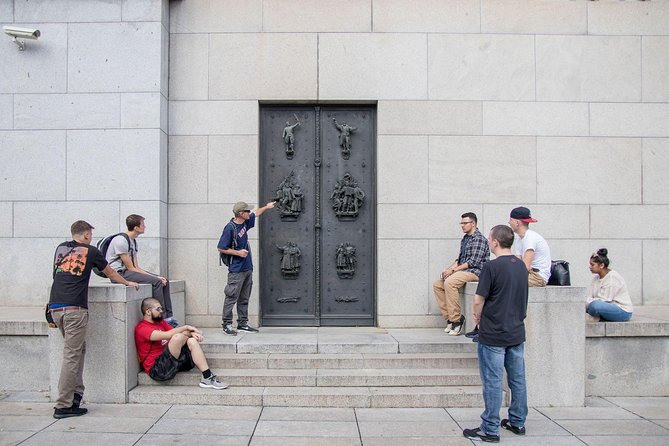
Cold War Prague still has fingerprints. I love the private historian guide who ties buildings to everyday life, and I love the way the route hits heavy hitters like Vitkov and Wenceslas Square without wasting time. One watch-out, there is a steep climb up Vitkov Hill that may be rough if you have mobility limits.
You pick morning or afternoon and stay with your own guide, usually up to 10 people. You also get tram tickets included, so you can focus on the story instead of transit stress.
This is not just monuments and photos. It is a guided walk through the sights, symbols, and pressure points that shaped life in Czechoslovakia from 1948 to 1989.
In This Review
- Key things I’d plan around
- Why this Prague Cold War walk feels different
- Route at a glance: how the 3 hours actually move
- Stop 1: Karlin-Zhizhkov pedestrian tunnel and the “still there” cold reality
- Stop 2: Vitkov Hill, the Hall of the Red Army, and Gottwald’s mausoleum
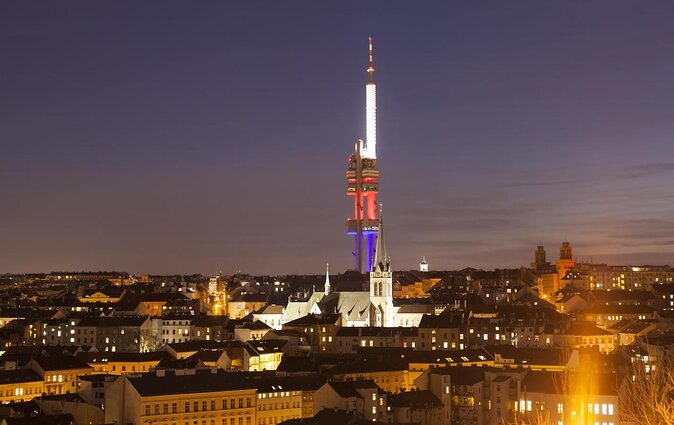
- Stop 3: Zizkov Television Tower, Brutalism as a Cold War backdrop
- Stop 4: Wenceslas Square, Prague Spring, tanks, and the 1989 Velvet Revolution
- Where the John Lennon Wall and Letna fit in
- Upside-Down King Wenceslas, and why irony matters in Central Europe
- Zizkov Tower viewpoint and the full story feel
- Price and value for a private group up to 10
- Practical tips: make the climb easier and the story stick
- Should you book this Private Prague Cold War Walking Tour?
Key things I’d plan around
- A truly private, small-group format means you can ask questions and go at a pace that fits your interests, not a fixed herd schedule.
- Vitkov Hill is the heart of the tour, with the Hall of the Red Army, the former mausoleum tied to Klement Gottwald, and big viewpoint payoff.
- Karlin-Zhizhkov’s pedestrian tunnel adds a chilling practical layer, including locked doors tied to nuclear bomb-shelter corridors still maintained.
- John Lennon Wall and the freedom-vs-control theme show how people pushed back with Western-style hope, right in public space.
- Wenceslas Square gives you the 1989 arc, including the lead-up from the Prague Spring era and the 1968 crackdown by Warsaw Pact tanks.
- Guides can make it personal, with praised storytelling from guides such as Alzbeta and Vadim who connect locations to lived experience and conversation.
Why this Prague Cold War walk feels different
A lot of Prague tours skim the surface: pretty streets, quick dates, move on. This one keeps the focus where it belongs, on how communist rule shaped public space and daily life from 1948 to 1989.
What I like most is the human scale of the explanation. You are shown physical sites, then given the political and social meaning behind them, from Soviet honors in stone to propaganda-era culture in the streets. It is history you can point to with your feet still on the pavement.
The second big plus is the private guide setup. Your group stays together, and the guide can slow down for the questions you care about. In particular, guides like Alzbeta have been praised for weaving locations with concrete context, including family-linked perspectives, while Vadim has been noted for friendly, engaging interaction and tying themes back to what you are seeing.
The possible drawback is not the walking in general. It is that one segment is genuinely uphill. If you struggle with stairs or steep climbs, you will want to plan for an alternate route that can skip Vitkov Hill and focus on other Cold War sites.
More of the years behind the Iron Curtain:
- Prague: Communism History and Nuclear Bunker Guided Tour
★ 4.7 · 2,417 reviews - Prague Communism History and Nuclear Bunker Tour
★ 5.0 · 1,742 reviews - Communism & Nuclear Bunker Tour + 70s Canteen Lunch (own expense)
★ 5.0 · 1,036 reviews
Route at a glance: how the 3 hours actually move
You start in central Prague near Náměstí Republiky, and you meet your guide 15 minutes early at Kostel Svaty Josef if you are not arranged for pickup. The tour is about 3 hours, and you can choose an afternoon or morning departure, depending on availability.
Expect a mix of short stops and a couple of longer site moments. The tunnel segment is brief but memorable. The big time investment is Vitkov Hill, where you get both the memorial buildings and the viewpoint, plus a steep climb that adds real effort.
Transportation is light. You get tram tickets included, and the itinerary is designed for walking between key areas rather than constant rides. The goal is to keep you outside, looking at the actual sites, not sealed inside vehicles.
Stop 1: Karlin-Zhizhkov pedestrian tunnel and the “still there” cold reality
The walk begins with a pedestrian tunnel in Karlin-Zhizhkov. This part works because it feels oddly practical, not ceremonial.
You spend around 10 minutes walking through the tunnel and noticing the locked doors that lead to nuclear bomb-shelter corridors built in the Cold War and still maintained. It is one of those details that makes the era feel real fast. You are not just hearing about fear and planning, you are seeing the infrastructure meant for it.
Admission here is free, so it is a low-cost way to set the tone. If you like when a tour starts with the human motive behind the monuments, this stop delivers early.
One small consideration, since this is a tunnel, it can feel enclosed. If you are sensitive to tight indoor spaces, plan to take it at an easy pace.
Stop 2: Vitkov Hill, the Hall of the Red Army, and Gottwald’s mausoleum
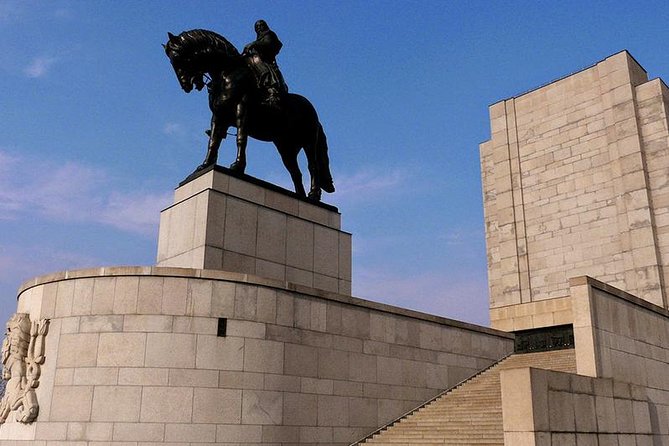
Vitkov Hill is the core of this Prague Cold War walking tour. The tour heads to the National Monument at Vitkov, which also centers the Hall of the Soviet Soldier and the former mausoleum of Klement Gottwald.
This is where you get the most “wow, that is exactly what power looks like” moments. The Hall of the Red Army features statues and decorative friezes designed to honor Soviet soldiers killed during World War II in Eastern Europe. It is Soviet commemoration made architectural, and the guide’s job is to help you read it beyond the obvious.
Then comes the part that few people expect on a casual city walk. You visit the mausoleum that once displayed the mummified body of Klement Gottwald, who served as Czechoslovakia’s President from 1948 to 1953. The tour also includes a peek into a laboratory and temperature-control center where staff worked to maintain the embalmed body.
Whether you feel curiosity, discomfort, or both, this section is powerful because it turns propaganda into physical detail. You can see how a regime treated death, image, and control as part of governance.
After the indoor and memorial elements, you climb the memorial for sweeping views over Prague, including the Old Town and the Žižkov Television Tower in the distance. That viewpoint matters because it gives you a mental map of the city’s layout, so later stops feel connected instead of random.
A key practical note: the climb up Vitkov Hill is about 20 minutes and is steep. If mobility is an issue, tell your operator so they can leave out Vitkov Hill and focus on other Cold War related sites.
Time-wise, plan around 30 minutes at the Vitkov complex. Admission is not included for this stop, so you may need to budget for entry separately. The tour also includes the broader National Monument context, including the monument’s commemoration of Czech and Slovak warriors of World War I, so you are not stuck in one era only.
Stop 3: Zizkov Television Tower, Brutalism as a Cold War backdrop
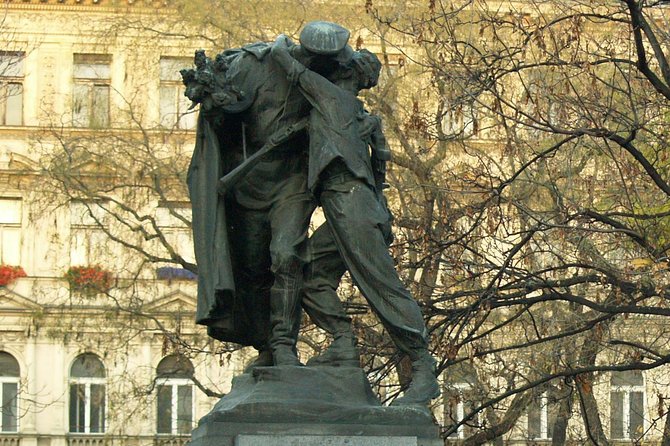
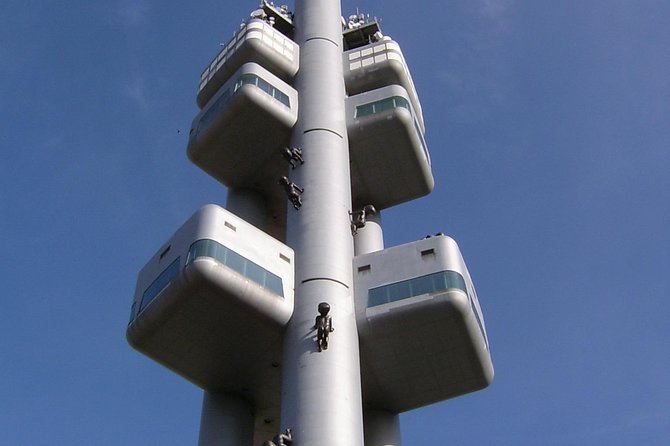
After Vitkov, you get a short visual break at the Prague TV tower, specifically Zizkov Television Tower. You spend about 5 minutes here, mainly to appreciate the best view of the Brutalist style tower.
It may seem like a quick stop, but it works because you are linking sightlines. You just saw the tower from afar during the Vitkov climb, and now you get closer to the idea that Prague’s modern skyline grew in the shadow of older political forces.
The admission here is free, so there is little risk. If you are running low on energy, this is a good stop to pause and simply look.
More guided walks around the centre:
Stop 4: Wenceslas Square, Prague Spring, tanks, and the 1989 Velvet Revolution
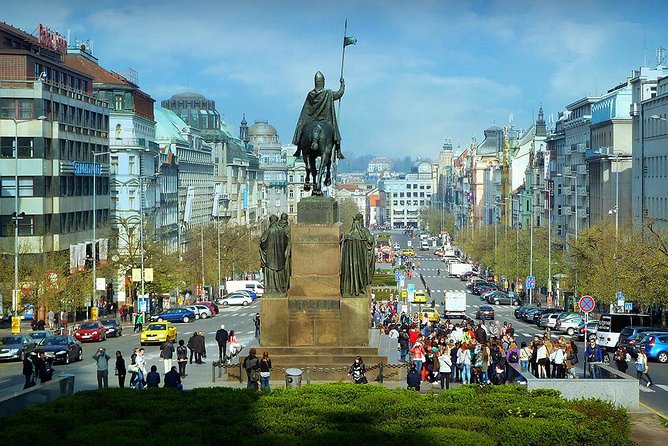
Wenceslas Square is the tour’s political climax. You walk around the square for about 20 minutes, considering how it developed over time, including its role in military parades under occupying powers and then the drama of the 1960s and late 1980s.
Your guide frames the Cold War stakes through two major moments.
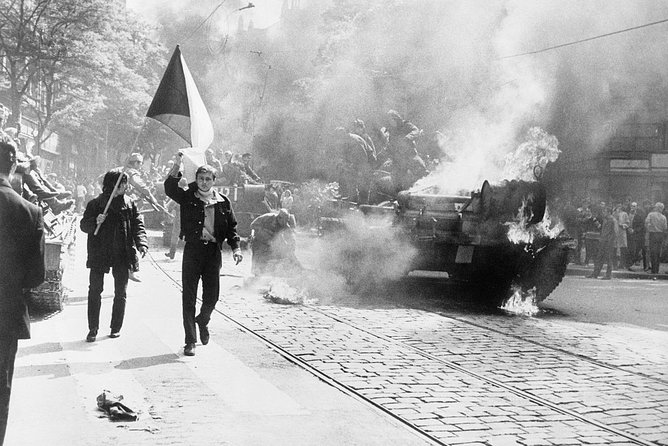
First is Prague Spring in 1968. You hear how Warsaw Pact tanks converged on the square to crush the reform movement, ending about eight months when freedom of speech and an independent press were allowed to blossom. This detail helps you understand why people treated the square as more than just a central meeting place.
Second is 1989 and the Velvet Revolution. You see the monuments honoring brave Czech protestors and learn how demonstrations gathered momentum until communist rule ended. This part lands best when you watch the space the way a protest would have. The guide helps you imagine how public confrontation works in a place built for spectacle.
Admission is free for this walk. The square is also easier than Vitkov in terms of effort, so it is a good place to reset your pace after the hill.
Where the John Lennon Wall and Letna fit in
Mid-route, the tour brings you toward other high-impact symbols of the Cold War era, including Letna Hill and the John Lennon Wall.
Letna Hill is where one of the world’s largest statues of Josef Stalin once stared down over the city. The contrast is the point. You see how enormous official power can be made into a public landmark, then later you see the opposite kind of landmark in the John Lennon Wall.
The John Lennon Wall is where people painted Western-style freedom messages of hope and revolution. It is street writing as politics, and it feels different from the formal monuments. Instead of honoring leaders with stone, people were using paint to argue for a different future.
This section matters because it shows the Cold War not just as a top-down story. It includes pushback, creativity, and ordinary voices in public space.
The tour still keeps it practical. Even if you do not feel like a graffiti person, the guide helps you read the wall as a political artifact.
Upside-Down King Wenceslas, and why irony matters in Central Europe
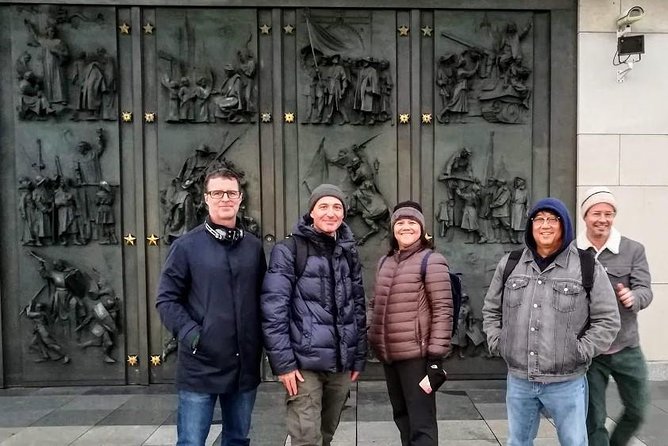
After Wenceslas Square, you stop for the upside-down statue of King Wenceslas riding a dead horse. It takes about 5 minutes, and it is exactly the kind of detail a normal sightseeing route skips.
The guide connects the irony to the political mood you see across Central Europe, where symbols are constantly reinterpreted. The statue is not just a joke. It is a visual cue that authority can be toppled, mocked, or turned on its head.
This is also a nice micro-break. You get one more meaningful symbol before you wrap up the tour.
Zizkov Tower viewpoint and the full story feel
One thing I appreciate about the pacing is how the tour stitches together views. Vitkov gives you a broad look over Prague, with the Žižkov Television Tower visible. Then you get a closer look at that tower, so you understand why it appears in the background of your Cold War mental map.
That matters because the Cold War was not one location. It was a system of control across the city, enforced through places of power, surveillance, and public messaging. The walking route makes that feel believable.
The tour ends with the monuments and symbols around Wenceslas Square and the upside-down Wenceslas statue, leaving you with a final impression that feels political and specific, not vague.
Price and value for a private group up to 10
At $390.37 per group, this is priced as a private experience rather than a per-person ticket. It is listed for up to 10 people, and the highlight notes also point to pricing based on six people or fewer, so the best value usually comes when you split the cost among a small group.
Here is a rough math check using the stated group pricing. If you had 6 people, that is about $65 per person. If you had closer to 10, it drops to about $39 per person. Either way, you are paying for a historian-led private walk that lasts about 3 hours and includes tram tickets.
The value also depends on what you want from a Prague tour. If you enjoy political context, site-specific storytelling, and asking questions, the private guide can feel worth it fast. If you only want a light overview of landmarks, you might prefer a cheaper group option.
One more value angle: the tour includes some stops with free admission and others where admission is not included. In practice, you are paying for access where it matters most, and you are not paying for every single step of the route.
Practical tips: make the climb easier and the story stick
Start with the obvious comfort advice. Wear shoes you can trust on uneven sidewalks and stairs, especially because of the steep climb up Vitkov Hill.
If you have mobility issues, be direct when you book. The tour specifically notes that they can leave out Vitkov Hill and focus on other Cold War sites, which is the kind of flexibility you want rather than forcing yourself through an unpleasant climb.
Bring your curiosity brain. This tour works best when you let the guide connect the dots for you. You will get the most out of it by asking simple questions like what changed from the 1940s to the 1980s, how public messaging worked, and why certain sites were chosen for commemoration.
Also, plan on short site moments rather than long museum-style time. The tour is built around walking and looking, with Vitkov as the big exception. The rest of the route moves at a pace that keeps the story flowing.
If you are pairing this with other Prague sightseeing, treat it as a foundational political tour. After this, you will read Prague’s symbolism differently when you see squares, statues, and walls.
Should you book this Private Prague Cold War Walking Tour?
Book it if you want a focused Prague Cold War walking tour with a private guide, and if you care about understanding how communist rule showed up in specific locations. The Vitkov Hill section, including the Hall of the Red Army and the former mausoleum tied to Klement Gottwald, is the kind of on-foot education that sticks.
Skip it or ask for adjustments if steep climbs are a dealbreaker. The tour can adapt by leaving out Vitkov Hill, but the hill is still a major part of the standard experience.
Finally, if you have even a modest interest in 1968 and 1989, this is a smart use of three hours. Wenceslas Square gives you the story arc in the place where it mattered, and the John Lennon Wall and Letna Hill pieces keep the tour from becoming only top-down propaganda.
If that combination sounds like your kind of Prague, you will likely leave feeling like you can actually read the city’s political language.
Just written up in Prague
- Private Transfer from Prague to Regensburg★ 5.0 · 1 review
- Prague: TV Tower Ticket & Novi Grad Digital Tour★ 5.0 · 1 review
- Prague to Dresden’s Old Town, Zwinger & Frauenkirche by Car★ 3.0 · 1 review
- Prague to Český Krumlov Private Guided Tour – With Mike★ 5.0 · 1 review
- Prague to Munich Private Transfer with 2 hours sightseeing★ 5.0 · 1 review
- Prague: 3-Hours Wars & Totality Guided Walking Tour★ 5.0 · 1 review
- Prague to Berlin Private Transfer with Optional Sightseeing★ 5.0 · 1 review
- The Plague Doctor of Prague: Self-Guided Mystery Puzzle Walk★ 3.0 · 1 review
Prague Guided Walking Tours, compared.
3-Hour Walking Tour of Old Town & Prague Castle
Read our review →
Ghost Walking Tour Where Legends Come To Life
Read our review →
Jewish Quarter Walking Tour with Admission Tickets
Read our review →
Prague Guided Walking Tour and Cruise with Authentic Czech Lunch
Read our review →
Old Town and Jewish Quarter Guided Walking Tour
Read our review →
Prague Ghost and Legend of Old Town Walking Tour
Read our review →
Prague 3-hour Afternoon Walking Tour including Prague Castle
Read our review →
Ghosts and Legends Nighttime Guided Walking Tour
Read our review →Browse the lists this tour appears in