
Reviewed · PRAGUE GUIDED WALKING TOURS
Prague Cold War Walking Tour
Cold War Prague is all around you. This 3-hour walk connects the city’s Communist-era symbols, from grim Cold War infrastructure to political flashpoints, into a story you can actually picture, led by a historian guide and paced for a small group. You get the kind of historical context that makes statues, buildings, and slogans mean something instead of just being scenery.
One thing to think about upfront: the route includes a steep climb up to Vitkov Hill. Expect the uphill push to take about 20 to 30 minutes, and if you do not want that, ask about an alternative that leaves out Vitkov Hill.
In This Review
- Key things to know before you go
- Cold War Prague on Foot, With a Historian’s Lens
- Price and Value: What $126.43 Buys in 3 Hours
- Meeting Point, Timing, and How the Small Group Works
- Stop-by-Stop: Nuclear Shelters, Monumental Propaganda, and the Road to 1989
- Stop 1: Karlin-Zhizhkov Pedestrian Tunnel and Cold War Security
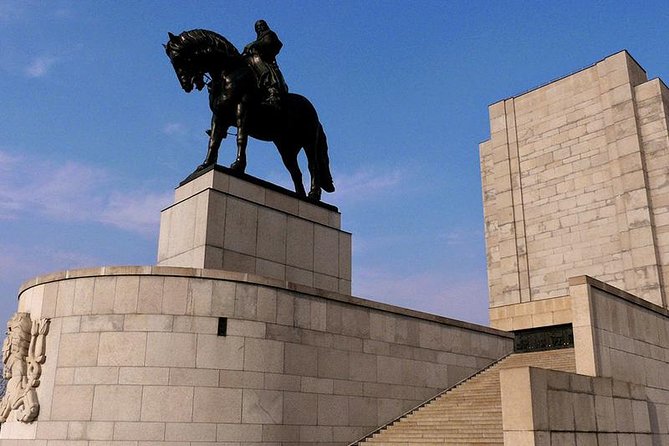
- Stop 2: Vitkov Hill, the Hall of the Soviet Soldier, and the Gottwald Mausoleum
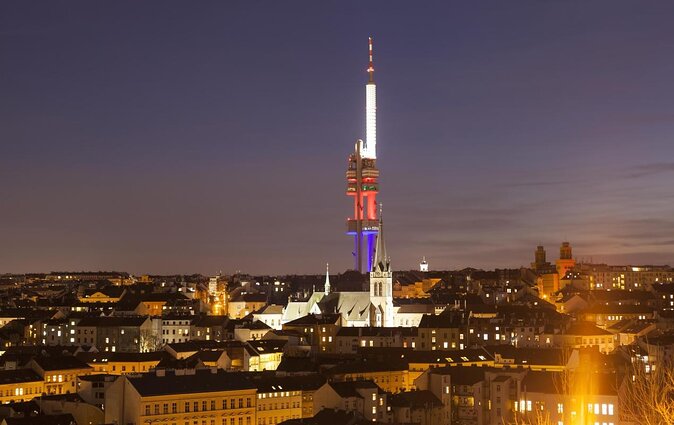
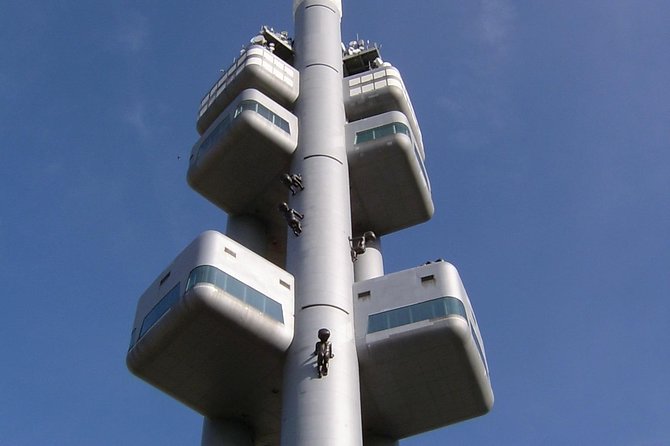
- Stop 3: Prague TV Tower for Brutalist Views
- Stop 4: Wenceslas Square, From Parades to the Velvet Revolution
- Stop 5: The Upside-Down Statue of King Wenceslas on a Dead Horse
- Other route highlights that often shape the story
- The Steep Climb Issue: How to Decide About Vitkov Hill
- Why This Tour Feels Smarter Than a Standard History Walk
- Who This Tour Suits Best (And Who Might Want a Different Plan)
- Should You Book This Prague Cold War Walking Tour?
- FAQ
- How long is the Prague Cold War Walking Tour?
- What is the price per person?
- What group size should I expect?
- Is the tour offered in English?
- Are tram tickets included?
- Is Vitkov Hill a difficult part of the tour?
- What is included and what is not?
Key things to know before you go
- Historian-led and small-group: a max group size of 8 means more Q and A time as you walk.
- You see propaganda in stone and steel: statuary, mausoleum symbolism, and state architecture get explained clearly.
- Cold War “infrastructure” stop: the Karlin-Zhizhkov pedestrian tunnel includes locked doors to nuclear bomb-shelter corridors.
- A big highlight with a climb: Vitkov Hill is the centerpiece, including the equestrian monument to Jan Zizka and the Gottwald site.
- Wenceslas Square is the political spine: you walk through centuries of conflict and end at the moment the Velvet Revolution took fire.
Cold War Prague on Foot, With a Historian’s Lens
Prague can feel like a history museum when you wander alone, but this kind of tour does something better. It gives you a framework for what you are seeing, so you do not just spot Communist-era details, you understand why they were built, what they were meant to signal, and what changed after 1989.
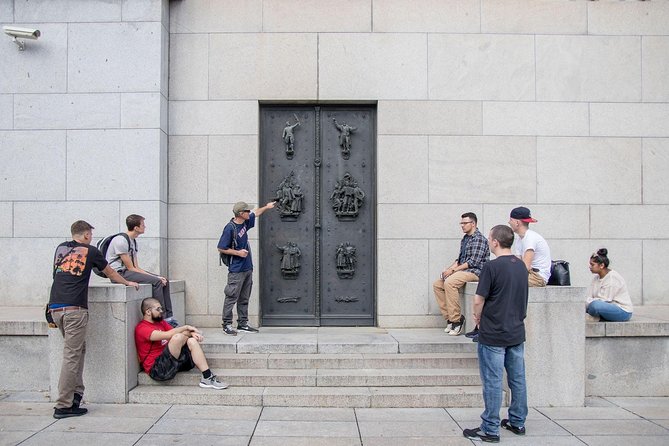
I like that the guide keeps the talk grounded in place. You start at the tour meeting point in Prague 1 (near Náměstí Republiky 1077/2), then you set out from the area around where the tour begins at St. Joseph Church. From there, the route is built around key Communist sites, not a random bundle of landmarks.
If you want a more “think while you walk” experience, this fits. One historian named Vadim has been singled out for an especially sophisticated, intellectual style, the kind that helps you connect propaganda, politics, and everyday life without drowning you in dates.
More of the years behind the Iron Curtain:
- Prague: Communism History and Nuclear Bunker Guided Tour
★ 4.7 · 2,417 reviews - Prague Communism History and Nuclear Bunker Tour
★ 5.0 · 1,742 reviews - Communism & Nuclear Bunker Tour + 70s Canteen Lunch (own expense)
★ 5.0 · 1,036 reviews
Price and Value: What $126.43 Buys in 3 Hours
At $126.43 per person, you are paying for guided expertise plus transit help, not just a walk. You also get tram tickets included, which matters in Prague where crossings and district jumps can eat up time if you are on your own.
Here is the practical value: in about 3 hours you cover multiple Cold War touchpoints that are harder to interpret without context. You look at a tunnel with Cold War defense infrastructure, you spend time at the monumental Vitkov site, and you walk through Wenceslas Square, one of the city’s central political stages. Even if some stops are free to visit, the guide’s explanation is the part that turns it from “sightseeing” into a real understanding of how Communist power operated.
What is not included is also worth noting. You are on the hook for food and drinks, and there is no hotel pickup or drop-off. So plan to eat before or after, and come with a water bottle if you run hot on uphill stretches.
Meeting Point, Timing, and How the Small Group Works
This tour runs in English, and it offers a choice of morning or afternoon departure. One listed start time is 2:00 pm, and your confirmation is typically sent within 48 hours based on availability.
The maximum group size of 8 is not a small detail. It changes the vibe. You are not just a body in the flow line, you can ask about something you noticed, like a specific symbol on a monument or why a square mattered in a particular year.
The tour uses a mobile ticket, so it is ready on your phone when you meet. You will also have tram tickets, which helps you move between areas without burning your whole time just getting from point to point.
Stop-by-Stop: Nuclear Shelters, Monumental Propaganda, and the Road to 1989
This is not a cookie-cutter “look at the church, take a photo” walk. The stops are chosen to show Communist rule from multiple angles, including defense, personality cults, public messaging, and street-level protest.
Below is what each stop tends to deliver, plus the one drawback to be aware of.
Stop 1: Karlin-Zhizhkov Pedestrian Tunnel and Cold War Security
You begin with a short visit at the Pedestrian Tunnel Karlin-Zhizhkov. Expect about 10 minutes here. The big moment is noticing the locked doors that lead to nuclear bomb-shelter corridors built during the Cold War, and still maintained.
What makes this stop special is how physical it is. You see a reminder that state power was not only about parades and posters. It was also about survival planning, secrecy, and controlling what people could access in a crisis.
Drawback to plan for: a tunnel can feel cooler and dimmer than the street, and you might want to bring a light layer if you get cold easily.
More guided walks around the centre:
Stop 2: Vitkov Hill, the Hall of the Soviet Soldier, and the Gottwald Mausoleum
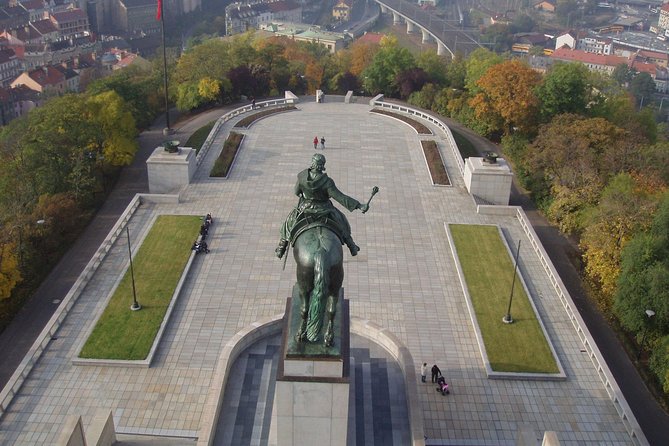
This is the tour’s centerpiece, and it is where the story gets most intense. You head to the National Monument at Vitkov. Plan about 1 hour at the monument area, and note that admission to the monument is not included.
What you will encounter around Vitkov includes:
- The Hall of the Soviet Soldier
- The former mausoleum display of Klement Gottwald, the first chairman of the Communist Party of Czechoslovakia, including his mummified corpse
- An adjoining laboratory where his body was embalmed
You also see the monument to Jan Zizka, with descriptions of why the equestrian imagery mattered in Czech nationalism within Communist rule. The equestrian statue itself is highlighted as one of the world’s largest, which makes the site feel less like a small memorial and more like a deliberate political statement in 3D.
One key consideration is time and effort. Vitkov Hill requires that steep climb, and the 20 to 30 minute uphill is real. If your legs are not happy with hills, do not force it. You will enjoy the tour more if you can keep moving comfortably.
Stop 3: Prague TV Tower for Brutalist Views
You get a brief stop near the Prague TV Tower (Zizkov Television Tower). It is short, about 5 minutes, and admission is free.
This stop works as a palate cleanser. After heavy monument material, you get a chance to look outward and absorb the city around you, especially the brutalist style of the tower itself. It is a good “pause” moment before you return to major political spaces.
If you are sensitive to crowds or wind, check the weather here. Elevated viewpoints can feel colder than street level.
Stop 4: Wenceslas Square, From Parades to the Velvet Revolution
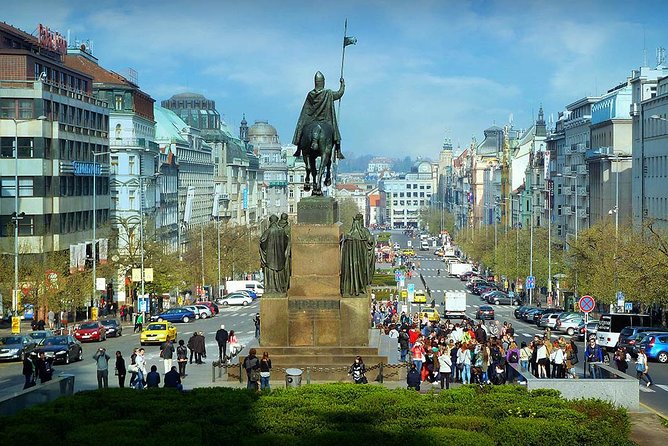
Now you shift into the political heart of the story: Wenceslas Square. You spend about 20 minutes walking through it, and there is no admission charge.
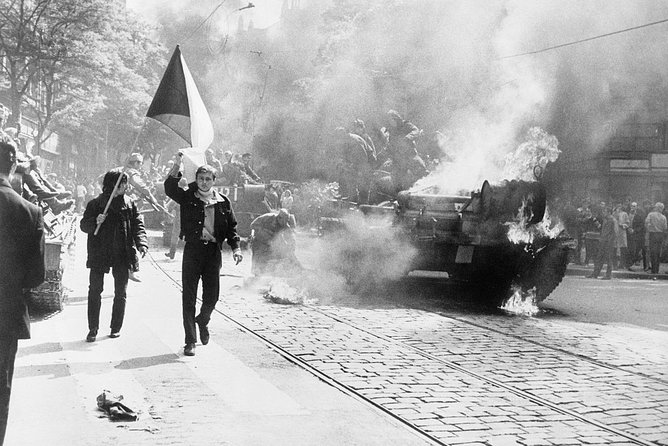
What the guide helps you connect is how the square’s role changes over time. You consider its founding in the 14th century, then how it became a stage for military parades during occupying powers. You also connect the emotions of earlier turning points like the tragic events tied to Prague Spring, and then you land on the Velvet Revolution, described as igniting in a single day.
This stop is the payoff for many people because it shows you how public space can flip quickly. A city square is not just a place to meet friends. It can become a megaphone.
A drawback to be aware of: it is a major public area, so it can be busy. If you want photos without shoulder-to-shoulder crowding, try to keep your shots quick and focus on what the guide points out.
Stop 5: The Upside-Down Statue of King Wenceslas on a Dead Horse
You finish with the irony of the Upside-Down Statue of King Wenceslas riding a dead horse. Plan about 5 minutes.
This is a small stop with a big point. The guide uses it to talk about how Central Europe’s political mood can be read through humor, distortion, and public art. It is the kind of detail that can slip past you if you are only hunting for famous monuments.
Practical note: because it is short, you should treat it like a “pay attention” stop. Read the symbolism, then take your photo.
Other route highlights that often shape the story
Even when the “big time stops” are the ones above, the route typically weaves in more sites that strengthen the Cold War theme. You may see:
- The Hall of the Red Army and Communist-era statuary and decorations linked to the 1948 power shift, including discussion of KSC propaganda and politics
- A mausoleum and embalming story tied to Klement Gottwald, with the adjoining laboratory concept
- Letna Hill, formerly the site of an enormous Stalin statue, and the tragic story of its sculptor
- The John Lennon Wall, connected to political protest
- The National Assembly building, described as the Communist government seat before the post-1989 shift
If any of those subjects interest you most, this is a good sign. The tour is designed to make these things feel like a connected chain, not separate trivia.
The Steep Climb Issue: How to Decide About Vitkov Hill
Because Vitkov Hill is the only “hard line” physically on this route, I recommend you make the decision early.
You are looking at:
- A steep climb with 20 to 30 minutes uphill
- A monument visit where the guide’s explanations matter, so it is not a “quick look and go” segment
If you have trouble with hills, you are better off planning for the tour option that leaves out Vitkov Hill and still focuses on Cold War sites in the city center. That way you can keep enjoying the story without spending the whole time thinking about your legs.
If you are moderately fit and you can handle stairs and uphill walking, go for it. Vitkov is where the tour’s meaning becomes most visible.
Why This Tour Feels Smarter Than a Standard History Walk
A lot of “themed tours” tell you what a building is, then move on. This one tries to show you why the Communists used symbols so hard.
You see it in how power is staged:
- Defense as a hidden reality, like the tunnel doors and bomb-shelter corridors
- Personality cults, like the Gottwald mausoleum and the embalming laboratory idea
- Monument scale, like equestrian imagery used for national messaging under a Communist system
- Public squares as turning points, like Wenceslas Square and the Velvet Revolution moment
And because the guide is a historian, the talk tends to keep you from falling into one-sided storytelling. You get the rise of Communism in Czechoslovakia, then the Velvet Revolution’s impact, and the ongoing echoes in the modern Czech Republic. That last part is important. It helps you read current politics without pretending the 20th century ended cleanly.
Who This Tour Suits Best (And Who Might Want a Different Plan)
You will like this tour if you:
- Enjoy political history and symbolism more than just “pretty streets”
- Prefer a structured walk with context
- Want a small-group format with room to ask questions
- Like the idea of seeing Cold War life as practical systems, not only ideology
You might skip it or choose the no-Vitkov option if you:
- Know you struggle with steep uphill walking
- Are looking for a relaxed, low-effort stroll only
If your travel style is “I want the stories behind the stones,” this hits your sweet spot.
Should You Book This Prague Cold War Walking Tour?
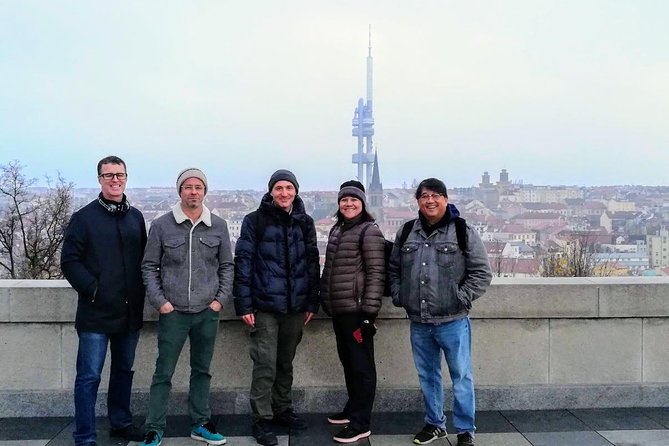
Book it if you want a guided, historian-led way to understand Prague’s Communist-era footprint, with the tour pacing set for a small group and the stops chosen for real meaning, not just famous photo spots. The included tram tickets help you keep your time efficient, and the blend of monuments, public squares, and protest sites gives you a strong arc from Cold War life toward the Velvet Revolution.
Think twice if you do not want a hill-based challenge. In that case, go for the alternative that avoids Vitkov Hill, because you will get more out of the tour when you are not fighting the climb the entire time.
If you are even mildly curious about how propaganda, fear, and public protest shaped everyday life in Czechoslovakia, this is one of the more purposeful ways to spend 3 hours in Prague.
FAQ
How long is the Prague Cold War Walking Tour?
The tour lasts about 3 hours.
What is the price per person?
The price is $126.43 per person.
What group size should I expect?
The tour has a maximum of 8 travelers.
Is the tour offered in English?
Yes, it is offered in English.
Are tram tickets included?
Yes, tram tickets are included.
Is Vitkov Hill a difficult part of the tour?
Yes. The tour involves a steep climb to Vitkov Hill. It can take about 20 to 30 minutes uphill, and there is a recommended alternative that skips Vitkov Hill for those who have difficulty climbing.
What is included and what is not?
Included items are a historian guide and tram tickets. Food and drinks are not included, and there is no hotel pickup or drop-off.
Just written up in Prague
- Private Transfer from Prague to Regensburg★ 5.0 · 1 review
- Prague: TV Tower Ticket & Novi Grad Digital Tour★ 5.0 · 1 review
- Prague to Dresden’s Old Town, Zwinger & Frauenkirche by Car★ 3.0 · 1 review
- Prague to Český Krumlov Private Guided Tour – With Mike★ 5.0 · 1 review
- Prague to Munich Private Transfer with 2 hours sightseeing★ 5.0 · 1 review
- Prague: 3-Hours Wars & Totality Guided Walking Tour★ 5.0 · 1 review
- Prague to Berlin Private Transfer with Optional Sightseeing★ 5.0 · 1 review
- Step Back in Time: Discover Kutna Hora’s Magic with Mytripline★ 5.0 · 1 review
Prague Guided Walking Tours, compared.
3-Hour Walking Tour of Old Town & Prague Castle
Read our review →
Ghost Walking Tour Where Legends Come To Life
Read our review →
Jewish Quarter Walking Tour with Admission Tickets
Read our review →
Prague Guided Walking Tour and Cruise with Authentic Czech Lunch
Read our review →
Old Town and Jewish Quarter Guided Walking Tour
Read our review →
Prague Ghost and Legend of Old Town Walking Tour
Read our review →
Prague 3-hour Afternoon Walking Tour including Prague Castle
Read our review →
Ghosts and Legends Nighttime Guided Walking Tour
Read our review →Browse the lists this tour appears in