
Reviewed · PRAGUE GUIDED WALKING TOURS
Prague Art Nouveau and Cubism Walking Tour
Prague looks different once you spot the details. This 3-hour small-group walking tour links Art Nouveau flourish with Cubism geometry, with a historian guide helping you read Prague’s buildings like a living textbook.
I love that the small group size keeps the pace human and the questions welcome. I also like that the route leans on major design moments like Obecní dům and the House of the Black Madonna, plus the guide’s practical explanations of how these movements actually worked.
One possible drawback is that at $126.71 per person, it may feel a bit pricey at first glance, especially if you’re only after photos. The good news is that the stops are short, focused, and worth it if you enjoy architecture and context.
In This Review
- Key things that make this tour worth it
- Prague Art Nouveau and Cubism, street by street
- Start at Ovocný trh, end near Café Louvre (and keep exploring)
- Why a historian guide changes the whole architecture game
- Cubism stop: House of the Black Madonna
- Art Nouveau icon: Obecní dům and the Czech design identity
- K+K Hotel Central, Prague’s first Art Nouveau chapter
- Café Imperial: short stop, strong atmosphere
- Cubism and national story: Czechoslovak Legion Bank
- Prague Main Train Station dome: Art Nouveau meets engineering
- Wenceslas Square: Art Nouveau and Art Deco in the same breath
- Lucerna Music Bar arcades: optimism in glass, stone, and design
- The Upside-Down King Wenceslas: a modern symbol with deep roots
- What makes the $126.71 price feel like value
- Practical tips so you enjoy it more
- Should you book this Prague Art Nouveau and Cubism walking tour?
- FAQ
- How long is the Prague Art Nouveau and Cubism Walking Tour?
- Where does the tour start and where does it end?
- Is the tour offered in English?
- How large is the group?
- What’s included in the price?
- Are museum tickets or admissions required at the stops?
- Should you book this Prague Art Nouveau and Cubism walking tour?
Key things that make this tour worth it
- A small group capped at 8, so you can ask questions instead of just listening
- Ginkgo leaves and curvy typography on Art Nouveau facades, explained clearly
- Cubism stops with big impact, including the House of the Black Madonna
- A construction-tech story, from central heating and ventilation to hydraulic elevators
- Turn-of-the-century optimism in spaces like Lucerna Music Bar
- A route that ends near places you’ll actually want to eat and wander next
Prague Art Nouveau and Cubism, street by street
Prague has two building languages you can learn to “hear.” One is the swirling, plant-like charm of Art Nouveau, with its love of light fixtures, flowing forms, and ornament that looks almost grown rather than made. The other is Cubism, sharper and more angular, turning buildings into crystal-like shapes and pyramid forms that feel strangely modern.
On this tour, the historian guide doesn’t just name styles. You start noticing patterns: gingko leaves on Art Nouveau surfaces, the way Eastern art and aesthetics fed the movement, and how Czech artists and architects pushed these ideas forward. Then Cubism arrives like a visual shock, and the contrast helps everything click.
You’ll also get the bigger picture that architects always deal with: history. As European wars changed the direction of life in Prague, the design mood shifted too. That context is why these buildings feel more than decorative. They’re connected to politics, national identity, and the culture of the time.
More guided walks around the centre:
- Prague: 3-Hour Walking Tour of Old Town & Prague Castle
★ 4.7 · 5,696 reviews - Prague: Ghost Walking Tour Where Legends Come To Life
★ 4.4 · 5,253 reviews - Prague: Jewish Quarter Walking Tour with Admission Tickets
★ 4.7 · 3,729 reviews
Start at Ovocný trh, end near Café Louvre (and keep exploring)
You meet at Ovocný trh 19 in Staré Město, then the walk finishes near Café Louvre (Národní 22). I like this setup because you’re not stuck far from dinner options after 3 hours.
The meeting area is central, and the tour is planned so you’re moving through the main historic core at a comfortable walking pace. Expect an itinerary that mixes quick landmark stops with short stretches of street-level looking. If you’re the type who enjoys pausing to actually study carvings, domes, and façades, this format works.
Also, this is built for a maximum group size of 8. In practice, that means you’re less likely to get lost in the back of a crowd, and the guide can adjust if someone wants extra time on a specific building detail.
Why a historian guide changes the whole architecture game
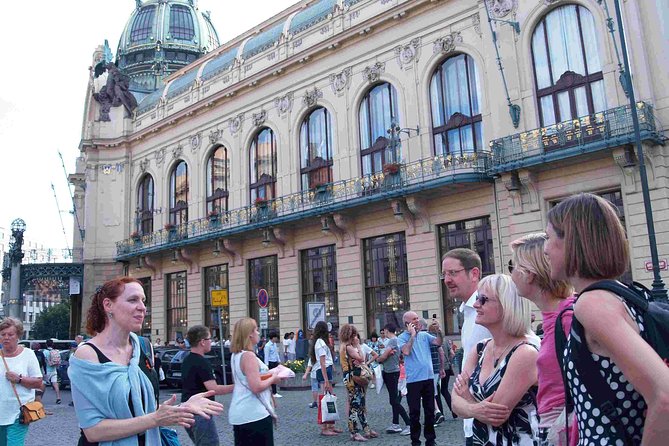
Without a guide, it’s easy to treat Art Nouveau and Cubism as pretty styles, like clothing. With a historian, you start connecting the dots between form and why it happened.
Here’s what you’re likely to hear in a way that sticks:
- What to look for on façades (plants, lines, typography, geometric patterns)
- How Eastern art influenced Art Nouveau, from decoration choices to the feel of the design
- How to spot Cubism features that aren’t always obvious at first glance
- Why buildings had to function, not just look good
One of the most praised parts of the experience is the guide approach. People like Vadim, Matous, Betty, Bonita, and Vitam (you may meet one of these guides or someone with the same teaching style) tend to explain architecture with passion and humor, and they leave room for questions. On rainy days, the focus stays on getting you to the right places and keeping you from feeling rushed.
And yes, you’ll hear about technology too. This tour doesn’t treat “modern” as a vibe. It treats modern as real engineering decisions.
Cubism stop: House of the Black Madonna
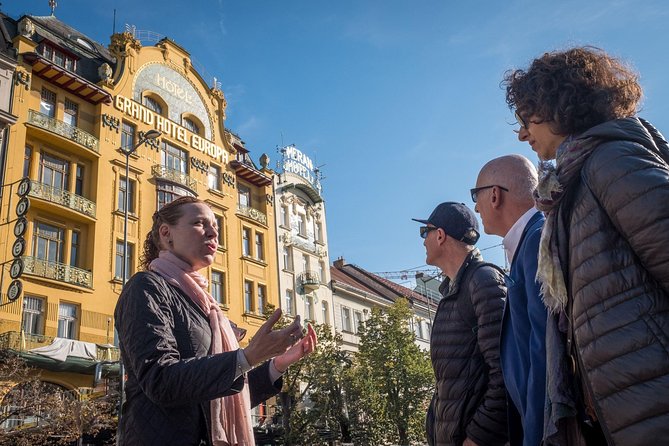
The walk kicks off with the House of the Black Madonna, a landmark in Cubist style.
This is the kind of building that makes you realize Cubism isn’t only for paintings. The shapes feel stacked, structured, and intentional, like the architect wanted you to experience form from the street level instead of only from a museum view. It’s also fast to see, which is useful early on, because it sets the contrast immediately.
If you want one mental trick for this stop, use this: don’t look for one feature. Scan the whole silhouette, then zoom in on angles and transitions. Cubism often shows itself in how volumes meet.
Art Nouveau icon: Obecní dům and the Czech design identity
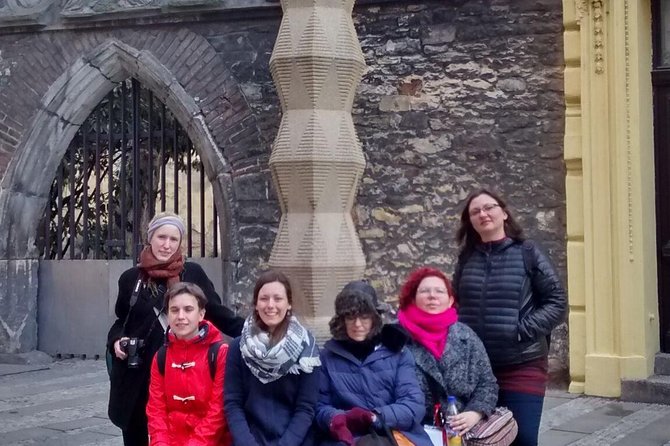
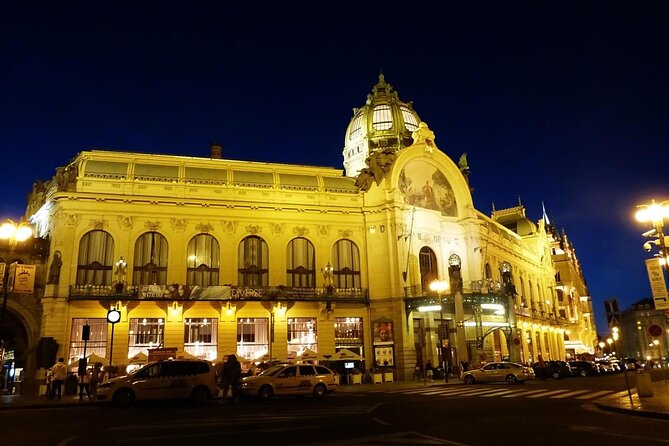
Next comes Obecní dům, one of Prague’s signature Art Nouveau landmarks. The tour gives you time to slow down and actually look, and that matters here.
What makes this stop so valuable is how it represents Czech Art Nouveau in a way that feels both elegant and public-facing. You’re not just looking at private taste. You’re seeing a statement about modern culture in a city trying to define itself.
A good guide will also point out how quickly Art Nouveau decoration can change your sense of scale. Facades that might look flat at first become layered once you notice lighting, patterns, and ornamental details. If you’re traveling with someone who thinks architecture is boring, this is often where you both start paying attention.
Drawback to consider: Obecní dům can be busy, especially near peak sightseeing hours. Plan to keep your eyes open and accept that you’ll share space with other visitors. The guide helps you focus on what to notice, which is the difference between “standing there” and learning something.
Another way the same evening in Prague could go:


K+K Hotel Central, Prague’s first Art Nouveau chapter
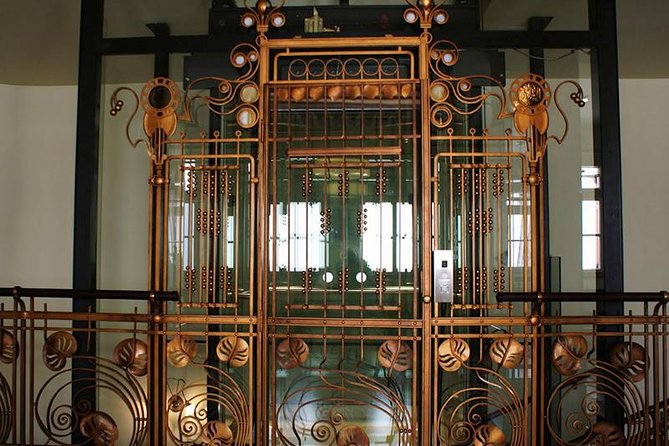
The route then takes you to the K+K Hotel Central Prague, described as the first Art Nouveau building in Prague. Even if you only have 10 minutes here, it’s an important one, because it places Art Nouveau into a timeline.
When you’re on the street and you see “first,” it changes how you look at the rest of the city. You start asking: what elements were new at the time? What did they change compared to earlier styles? And why did people embrace it?
This is also a stop where the guide’s ability to connect design choices to cultural influences helps. Art Nouveau often feels like it belongs to nature, but it also belongs to politics and identity. In Prague, that link becomes especially clear as the tour moves toward Cubism and then onward into the 20th-century story.
Café Imperial: short stop, strong atmosphere
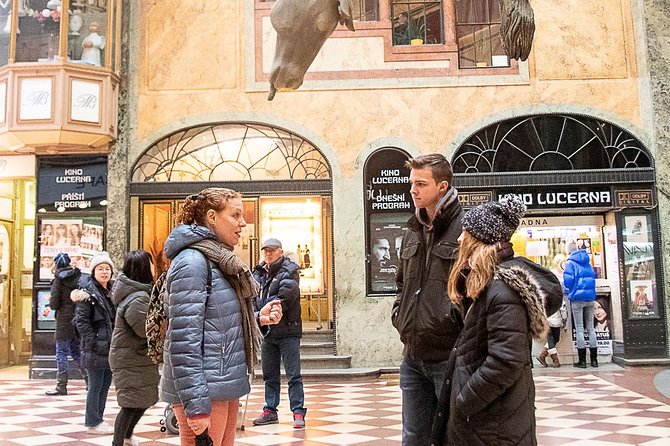
Next is Café Imperial, with time set aside for a quick but memorable look at its Art Nouveau interior.
Five minutes might sound short, but it’s the kind of stop that works as a palate cleanser. You’re shifting from exterior details to interior mood. Art Nouveau often uses space and light as part of the design, so stepping into an interior view helps you understand that this style isn’t only about the outside of a building.
If you like to keep moving, this stop is efficient. If you want to linger, bring the mindset that the guide will point out what matters, then you can return later on your own if the place pulls you in.
Cubism and national story: Czechoslovak Legion Bank
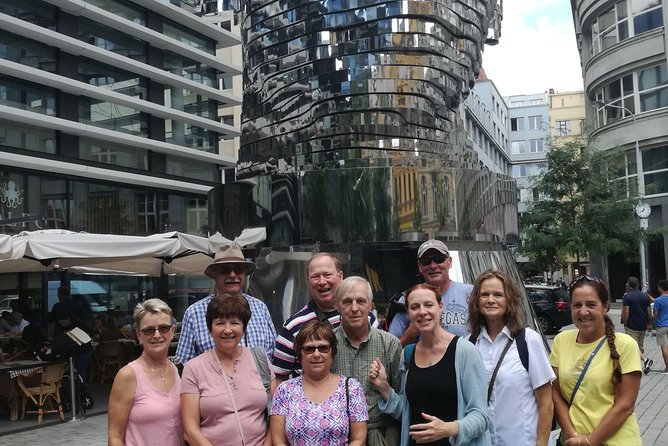
Then it’s on to the Czechoslovak Legion Bank, with Cubist architecture and an interior dedicated to the Czechoslovak Legion of the First World War.
This stop is more than style spotting. It connects architecture to memory. In Prague, many design landmarks are tied to the way people have told their national story, including the drive for identity during and after major wars.
The practical value for you: you’ll learn to read symbolism without needing a degree. Cubist design can be explained as an artistic language, but it can also be linked to how a society wanted to look modern, disciplined, and forward-thinking during turbulent times.
If your focus is purely architecture, you’ll still get something here. A strong guide points out the way interiors can carry the same design logic as the exterior, even when the “topic” is historical or political.
Prague Main Train Station dome: Art Nouveau meets engineering
The tour moves to Praha hlavní nadrazi (Prague Main Train Station), where you’ll see the famous interior Art Nouveau dome.
This is one of those places where architecture and infrastructure share the spotlight. Station spaces naturally feel large and public, so Art Nouveau in this environment becomes less about delicate ornament and more about creating a sense of grandeur and civic pride.
Here’s where the guide’s technology story becomes especially interesting. You’ll hear about groundbreaking construction choices such as central heating and ventilation, drinking water systems, hydraulic elevators, and steam-powered laundry, plus even an intercom system. That’s the kind of detail that makes the city feel tangible, not just aesthetic.
Why this matters for you: it gives context for why certain building choices were made. Style is never separate from practicality, and in a major hub like this, the blend of engineering and design is the point.
Wenceslas Square: Art Nouveau and Art Deco in the same breath
After the station, you reach Wenceslas Square, with time to discuss how the square reflects both Art Nouveau and Art Deco.
This is a smart stop because it helps you stop treating styles as neat boxes. Prague’s center shows a mix of eras side by side. As you walk the square, you’ll start noticing how newer decorative grammar changes the mood.
Practical tip: look for the shapes and details that repeat, and compare them to what you saw earlier. The guide’s running commentary usually makes those comparisons feel easy rather than academic.
Lucerna Music Bar arcades: optimism in glass, stone, and design
Next is Lucerna Music Bar, known for its Art Nouveau interior and the arcades of the space.
This stop is special because it gives you a “turn-of-the-century Czech optimism” angle. The guide frames it as avant-garde energy during a time when the city was changing fast. You’re also reminded that wars altered the trajectory of Prague’s story, so these spaces carry emotional history, not just design value.
If you like places where architecture and social culture meet, this is one to savor. Even in a short visit, arcades and interior design can feel like a different Prague tempo, slower and more theatrical.
The Upside-Down King Wenceslas: a modern symbol with deep roots
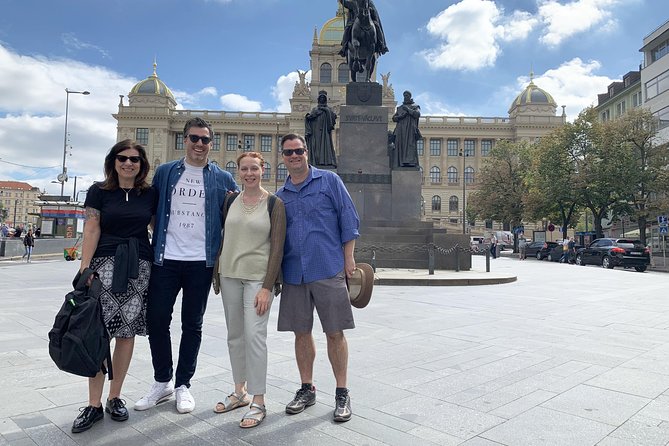
The walk ends with the Upside-Down Statue of King Wenceslas riding a dead horse, where the tour discusses the symbolism and places it in the context of Czech National Revival.
This last stop is a great “closing argument” because it shows how Prague’s relationship with identity didn’t stop in the Art Nouveau and Cubism era. The city keeps reinterpreting its figures and myths, and contemporary art becomes part of that conversation.
The value for you is perspective. After learning how earlier movements expressed modernity and cultural identity through design, it becomes easier to understand why modern sculptures can feel like commentary rather than decoration.
Also, ending near Café Louvre is a nice way to transition from architecture mode to real-life Prague. You’ll be near places to eat, sit, and keep wandering.
What makes the $126.71 price feel like value
At $126.71 per person, you should ask: what am I really paying for?
You’re paying for three things that matter more than the raw list of buildings:
- A historians guide who explains design and context, not just locations
- A small group that keeps the experience interactive
- A route where multiple stops are free to access (the tour lists admission ticket free at each stop)
Even if you’re not obsessed with architecture, the technology and history elements help you get more meaning out of every landmark you pass in Prague, including ones not on the route. That’s the real value of a strong architecture tour: it changes how you look at the city afterward.
If you’re debating whether it’s worth it, decide based on this question: do you want context, or do you only want photos? If you want context, this price starts to make sense quickly.
Practical tips so you enjoy it more
- Wear shoes you can walk in for about 3 hours, since you’ll move through central areas with frequent stops.
- Bring a rain layer. If the weather turns, the tour still works, but you’ll want to stay comfortable.
- Keep your curiosity switched on. The guide can tailor attention to your interests, including Czech design details like cubist form and Art Nouveau decoration.
- If you’re traveling as a family or mixed ages, this tour tends to work well because the stops are short and the explanations can be adjusted to different attention spans.
Should you book this Prague Art Nouveau and Cubism walking tour?
Book it if you want a compact route through Prague’s most readable design eras, with clear explanations and a historian guide who can answer your questions. The combination of Art Nouveau details (like ginkgo motifs and light-flecked interiors) and Cubism geometry (like the House of the Black Madonna and Cubist bank design) makes the contrast feel rewarding rather than confusing.
Skip it if you’re only doing architecture in the very casual sense, or if you dislike walking and prefer museum-only plans. Also, if the idea of discussing symbolism and historical context doesn’t sound fun, you may want a lighter sightseeing option instead.
FAQ
How long is the Prague Art Nouveau and Cubism Walking Tour?
It’s approximately 3 hours.
Where does the tour start and where does it end?
It starts at Ovocný trh 19, Staré Město and ends near Café Louvre, Národní 22.
Is the tour offered in English?
Yes, it’s offered in English.
How large is the group?
The tour has a maximum of 8 travelers.
What’s included in the price?
The tour includes a historian guide. Food, drinks, and hotel pickup or drop-off are not included unless specified.
Are museum tickets or admissions required at the stops?
The tour lists stops as Admission Ticket Free. You’ll also use a mobile ticket for the experience.
Should you book this Prague Art Nouveau and Cubism walking tour?
Yes, if you enjoy architecture you can actually “read,” and you want Prague’s style history tied to real context, not just names. It’s a strong choice for first-time visitors who want their second day in Prague to feel easier, because you’ll spot Art Nouveau and Cubism details right away.
Just written up in Prague
- Private Transfer from Prague to Regensburg★ 5.0 · 1 review
- Prague: TV Tower Ticket & Novi Grad Digital Tour★ 5.0 · 1 review
- Prague to Dresden’s Old Town, Zwinger & Frauenkirche by Car★ 3.0 · 1 review
- Prague to Český Krumlov Private Guided Tour – With Mike★ 5.0 · 1 review
- Prague to Munich Private Transfer with 2 hours sightseeing★ 5.0 · 1 review
- Prague: 3-Hours Wars & Totality Guided Walking Tour★ 5.0 · 1 review
- Prague to Berlin Private Transfer with Optional Sightseeing★ 5.0 · 1 review
- The Plague Doctor of Prague: Self-Guided Mystery Puzzle Walk★ 3.0 · 1 review
Prague Guided Walking Tours, compared.
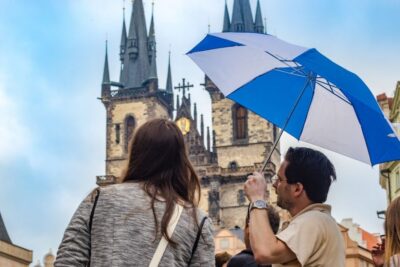
3-Hour Walking Tour of Old Town & Prague Castle
Read our review →
Ghost Walking Tour Where Legends Come To Life
Read our review →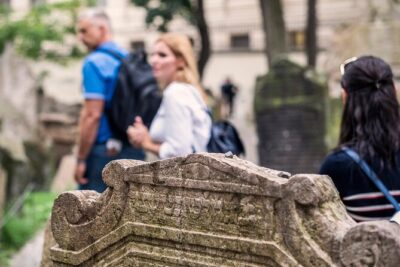
Jewish Quarter Walking Tour with Admission Tickets
Read our review →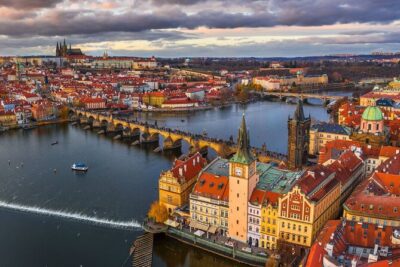
Prague Guided Walking Tour and Cruise with Authentic Czech Lunch
Read our review →
Old Town and Jewish Quarter Guided Walking Tour
Read our review →
Prague Ghost and Legend of Old Town Walking Tour
Read our review →
Prague 3-hour Afternoon Walking Tour including Prague Castle
Read our review →
Ghosts and Legends Nighttime Guided Walking Tour
Read our review →Browse the lists this tour appears in